BASF CONVERSATION
Paige Rozanski on Art as a Transformative Experience
From the experimental art collectives of the 1960s to Bobby Anspach’s singular vision of human interconnectedness.
NOVEMBER 2026
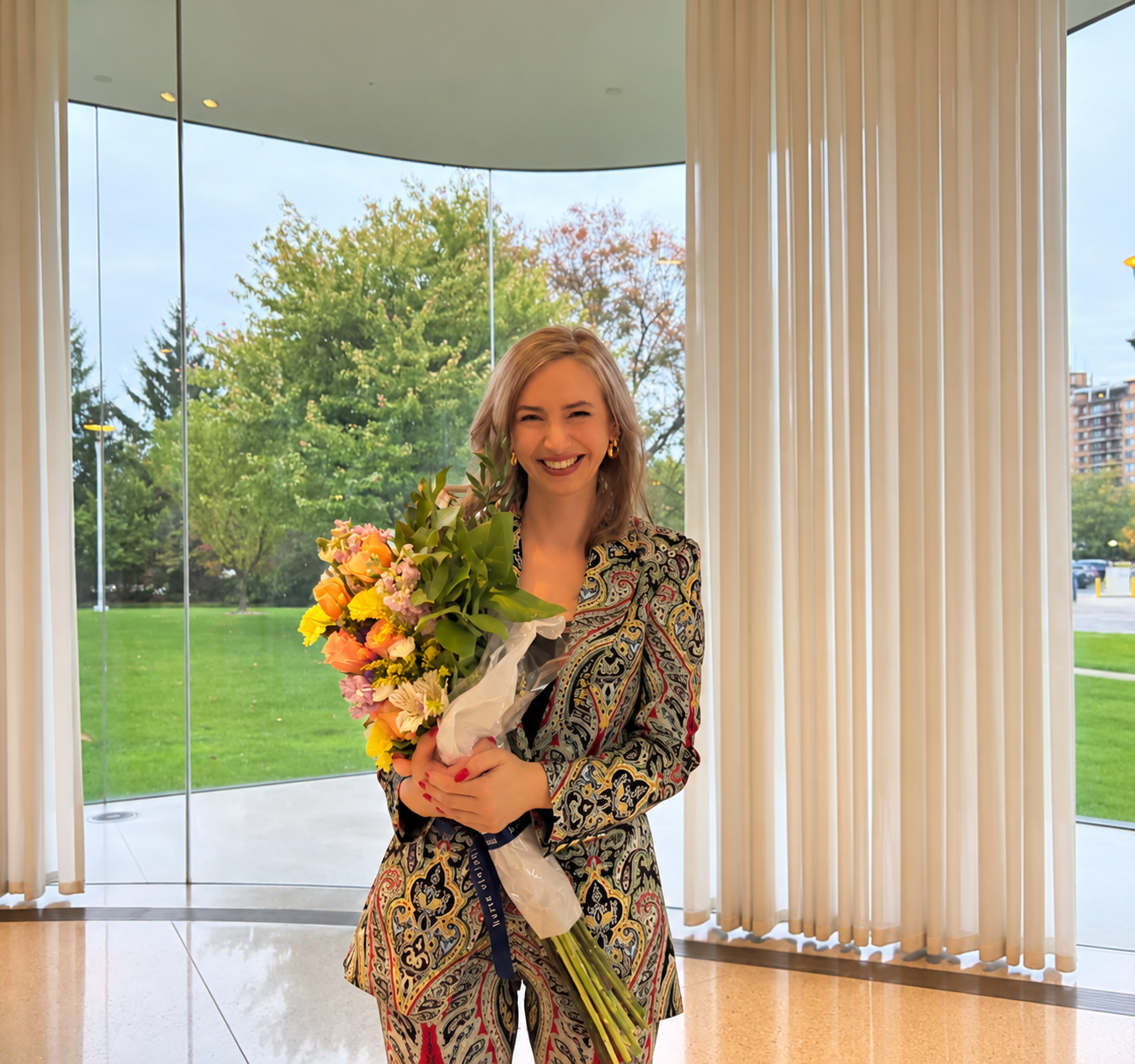
Paige Rozanski at the opening of Losing Ourselves Together: The Art of Bobby Anspach, 2026
Paige Rozanski is the Associate Curator of Modern and Contemporary Art at the Toledo Museum of Art, where she curated Losing Ourselves Together: The Art of Bobby Anspach, a solo exhibition dedicated to the artist's work. An interdisciplinary scholar whose interests span experimental artistic practices, cultural history, and the relationship between art and consciousness, Rozanski previously spent more than fourteen years at the National Gallery of Art in Washington, D.C.
During her tenure, she contributed to major exhibitions including Los Angeles to New York: Dwan Gallery, 1959–1971, Philip Guston Now, and The Land Carries Our Ancestors: Contemporary Art by Native Americans. Her research into USCO, a pioneering experimental art collective of the 1960s, reflects her longstanding interest in immersive environments, artistic collaboration, and the capacity of art to transform perception and experience.
Bringing Bobby's work to Toledo, the city where he was born, Losing Ourselves Together: The Art of Bobby Anspach invites visitors to experience his distinctive approach to light, sound, perception, and human connection. In the conversation that follows, Rozanski reflects on her curatorial journey, the unexpected connections between her research and Bobby's artistic vision, and the process of presenting artworks that ask audiences to both observe and become part of the experience.
THE CONVERSATION
BASF: What first sparked your curiosity about art and cultural history, and what led you into curating?
PR: I've always been interested in visual culture and cultural history more generally—art, film, music, and the cultural situations around them. I'm fascinated by how people knew one another, how they networked and collaborated, and how they lived their lives. I have a curious spirit, and I've always loved learning about something in depth.
As a teenager, I was especially interested in the music, social history, and counterculture of the 1960s. When I went to college, I attended a liberal arts school where I could design my own major. I initially studied anthropology and thought I might focus on music documentaries of the 1960s.
But when I studied abroad in Amsterdam, I became increasingly interested in art. I'd grown up in Washington, D.C., and had been fortunate to visit many of the free public museums there, so art had always been part of my life. In Amsterdam, I encountered early twentieth-century avant-garde art, including Mondrian. Seeing the progression of his work was eye-opening. I understood that he could paint representationally, but was choosing to do something different. That moment—realizing artists were challenging what art could be, turning away from figuration and moving toward abstraction—opened my mind to modern art.
I was also fortunate to take a class at Dia: Beacon while in college, with Michael Govan, who was the director at the time. That introduced me to minimal, conceptual, and land art in a profound way, and it connected back to my interest in the 1960s.
Coming out of college, I knew I wanted a creative career, but I wasn't someone who made things in the traditional sense. I loved reading, research, learning, and making connections—almost like making a visual collage. Curatorial work seemed like a way to bring those interests together. I decided I wanted to be a curator, and I feel fortunate that I found a profession that still speaks to those interests.
BASF: Your research has explored USCO, the experimental collective that brought together art, technology, and spiritual philosophy in the 1960s. How did that research begin?
PR: I first began working on USCO in graduate school at Columbia, in a course on expanded arts. We had to choose a topic for a paper, and USCO came up. There wasn't much written about the group at the time. I recognized the name from reading The Electric Kool-Aid Acid Test, but I never imagined my teenage interest in 1960s counterculture would become such an important part of my academic work.
I researched USCO and wrote the paper. I think there were several reasons they hadn't received much attention from art historians.
During my research, I went to Anthology Film Archives in New York. Someone there told me that Gerd Stern was still alive and gave me his email address. I reached out, thinking it would be wonderful to include his perspective in my paper. When I finished, I sent him the paper as a courtesy. He was incredibly encouraging and felt that I understood what the group had been trying to do.
That exchange began what has now been nearly twenty years of work on USCO. After graduate school, I helped Gerd begin archiving his collection, which is now at Stanford. I stayed in touch with him and, through him, developed a relationship with Michael Callahan, another participant in the group. Over time, those relationships became very close—they were like family to me.
While working at the National Gallery of Art, I kept finding opportunities to return to the project. This led to Gerd and Michael coming to the Gallery for a public conversation, film screening, and USCO performance using their original equipment and slides. It was one of their very few performances since the 1960s and 1970s. I also helped the Gallery acquire two USCO paintings.
During the pandemic, I returned to the research in greater depth with a collaborator, Devin Lander, who was studying Millbrook and the circle around Timothy Leary, Ralph Metzner, and Richard Alpert, later known as Ram Dass. We conducted hours of Zoom interviews with USCO artists. Many of the group's central participants have since passed away, so I'm grateful we had that opportunity. I was also awarded a sabbatical by the Gallery to support my USCO project. The research resulted in two papers, and I still have so much material to work through. I consider it a lifelong project.
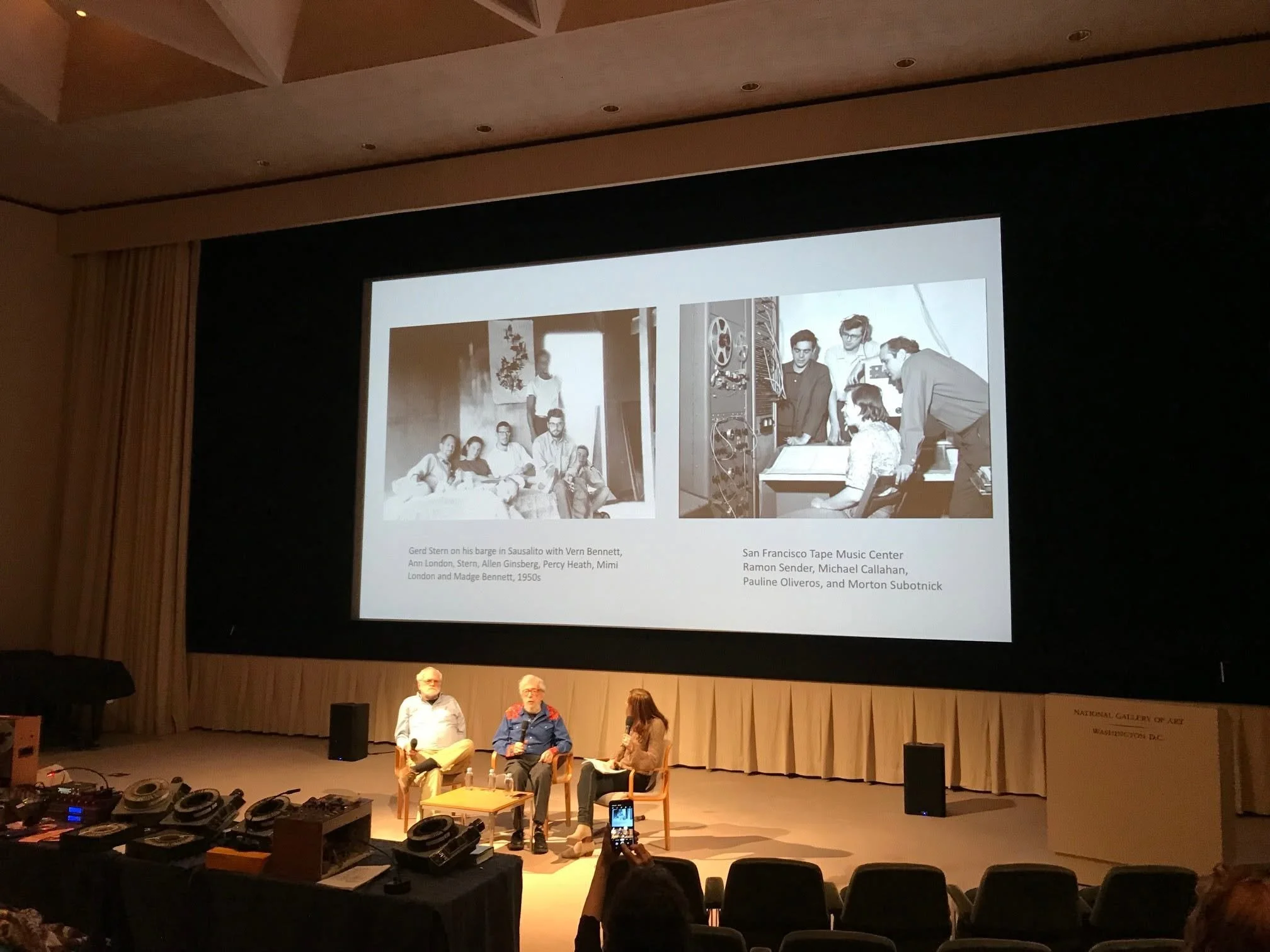
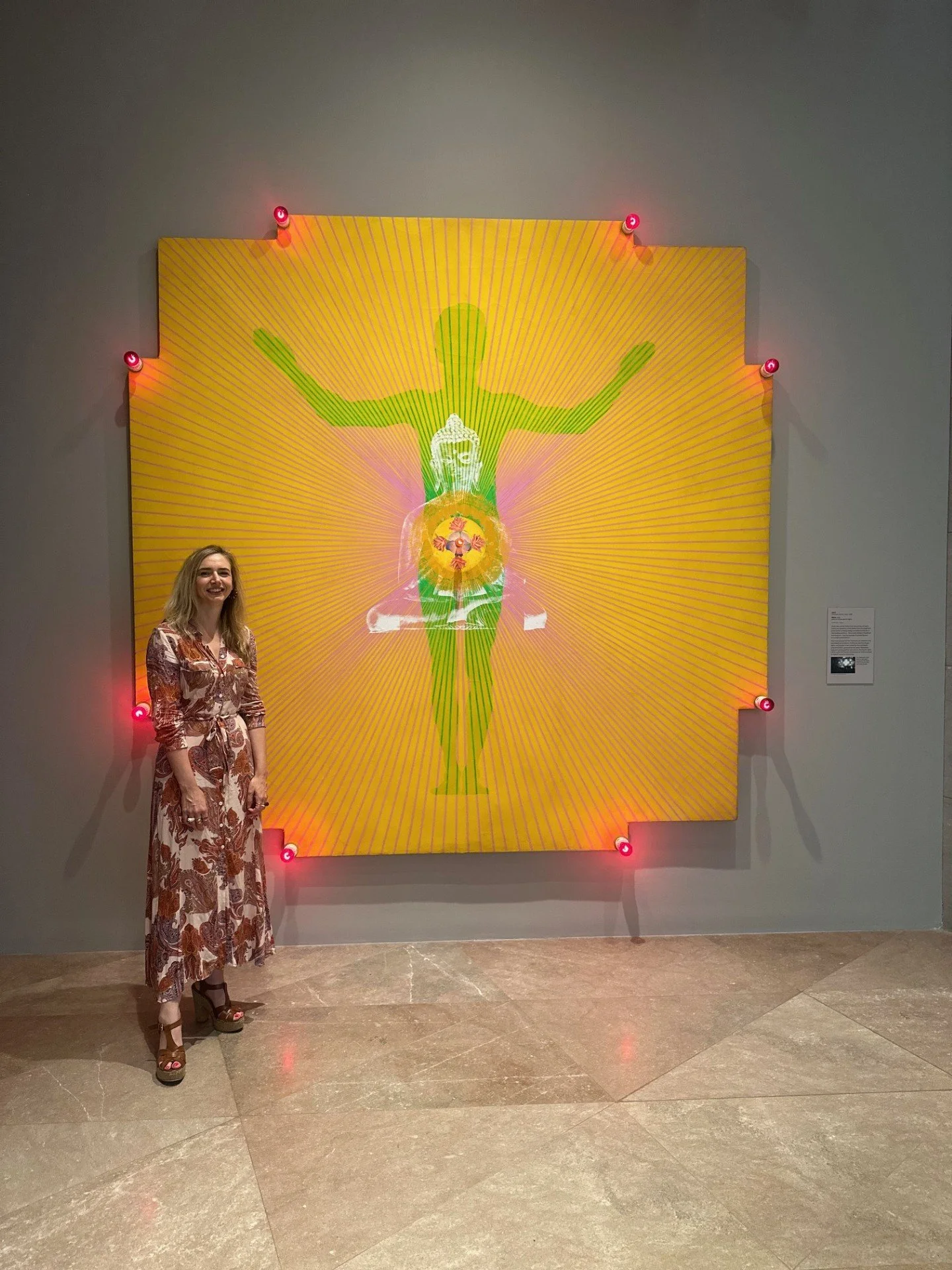
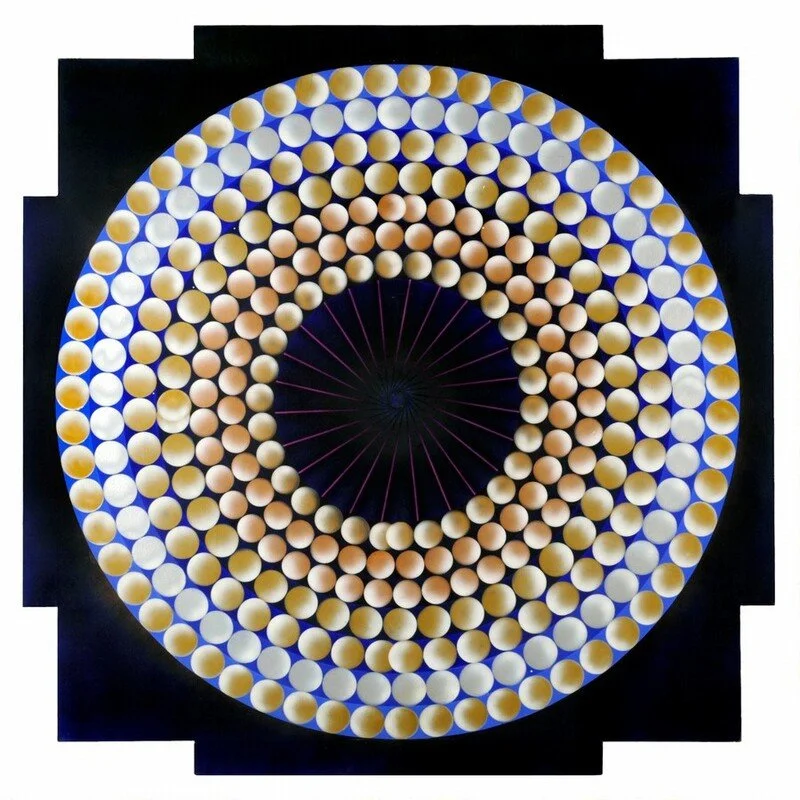
Above, from left to right: A conversation with USCO founding members Gerd Stern and Michael Callahan at the National Gallery of Art, Washington, D.C.; Paige Rozanski with Shiva (1965); and Spheres-Time (Tabernacle Painting) (1965). Both works by USCO were acquired by the National Gallery of Art.
BASF: What continues to fascinate you about USCO, particularly its approach to art and consciousness?
PR: One of the things that fascinates me is that USCO brought together people from such different backgrounds. Gerd Stern was a Beat poet. Steve Durkee was a painter who wanted to move away from the conventional art world. Michael Callahan worked at the San Francisco Tape Music Center, an important place for avant-garde music. Jud Yalkut was a filmmaker. Stewart Brand was involved for a time and later created the Whole Earth Catalog.
They brought their individual expertise to a shared project. They were influenced by Marshall McLuhan and early media theory, but also by Meher Baba, Buddhism, mysticism, and Eastern religions. They were asking how media might change consciousness.
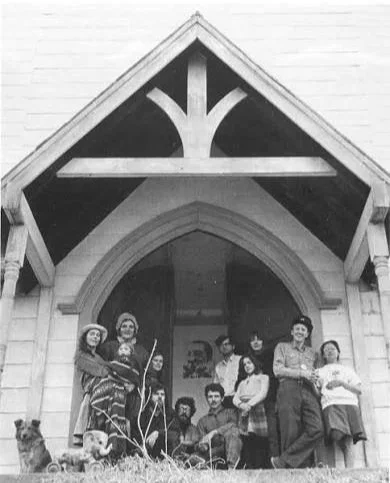
USCO and friends at the Garnervllle Church, April 1966, from left: Barbara and Steve Durkee (holding Dakota). Judi Stern, photographer Christopher George, Gerd Stern (below Meher Baba poster), electronics technician Owen Jones. Michael Callahan, Gerd Stem's daughter Radha, philosopher-logician Jane Burton, Stewart and Lois Brand (photograph © Stewart Brand; photograph provided by Asha Greer)
I think that's one of the most fascinating things about the 1960s: so many people were exploring consciousness, but through different avenues. USCO explored how media might shift consciousness; Timothy Leary and others were considering how psychedelics might do that; other people turned to Eastern spiritual practices or to living off the land. These different approaches were happening alongside—and sometimes in conversation with—one another.
USCO made immersive environments and performances at a time when very few artists were working that way. They adapted emerging technologies for purposes that were, in many ways, utopian. Their performances brought together projected slides, film, oscilloscopes, stroboscopic light, and found-sound collages. They created equipment to control and layer images, thinking not only about sensory intensity but also about how an experience would unfold—how it might build to a crescendo and then allow someone to come down from it.
I find that attention to the participant's experience incredibly interesting. They were creating situations that people entered and experienced.
USCO also moved across boundaries that art institutions often rely on. Their work could be ephemeral, performative, technological, or environmental. It wasn't necessarily something that could be bought or sold, which is another reason it didn't fit neatly into established art-world structures.
They worked in a church in Garnerville, New York. Some members lived there, but they didn't consider it a commune. It was a workspace. People came and went, contributing as the project required. That collaborative way of working was part of the vision.
I also think their ideas about media, interconnectedness, and what McLuhan called the “global village” feel remarkably prescient. Stewart Brand's later work on the Whole Earth Catalog, for example, invites connections to how we eventually came to think about information sharing and the internet. Whether our present-day systems fulfill those early utopian hopes is another question. But the relevance of USCO's work has become increasingly clear to me.
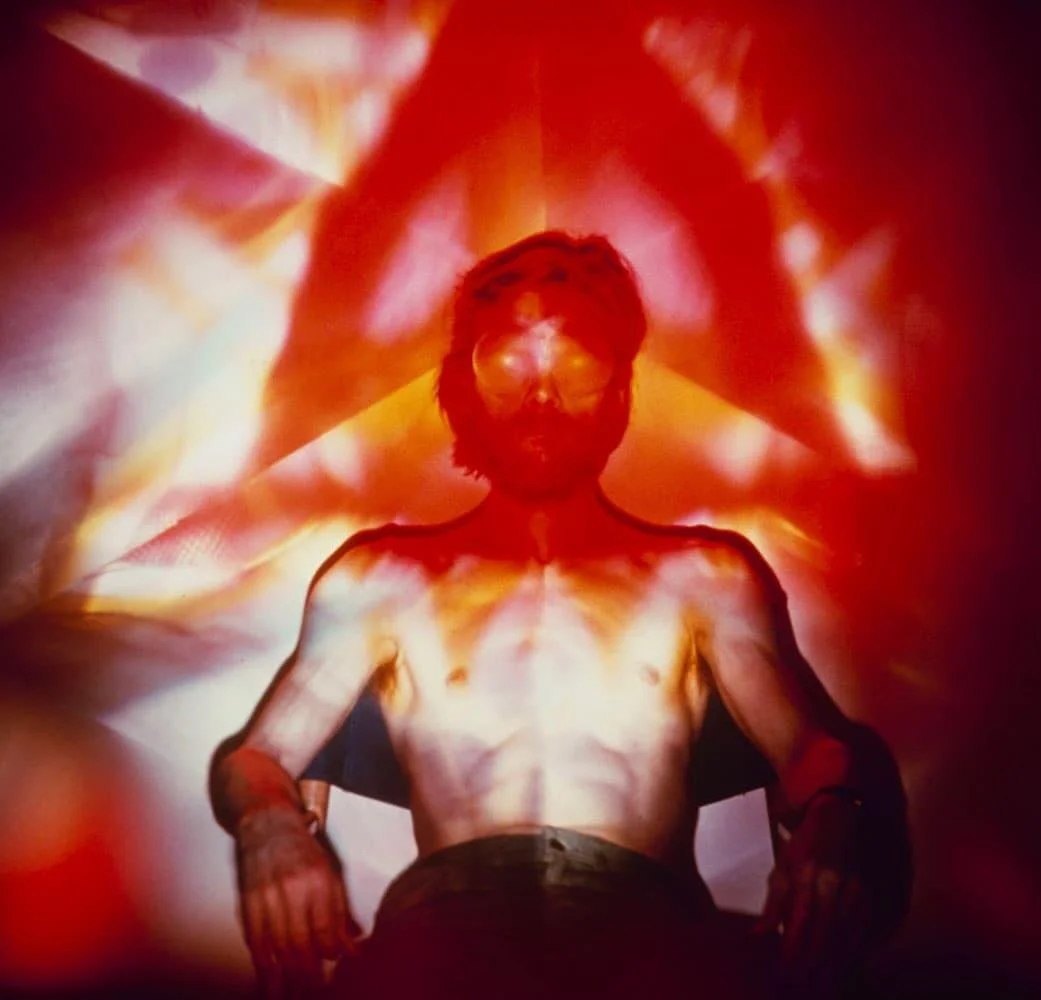
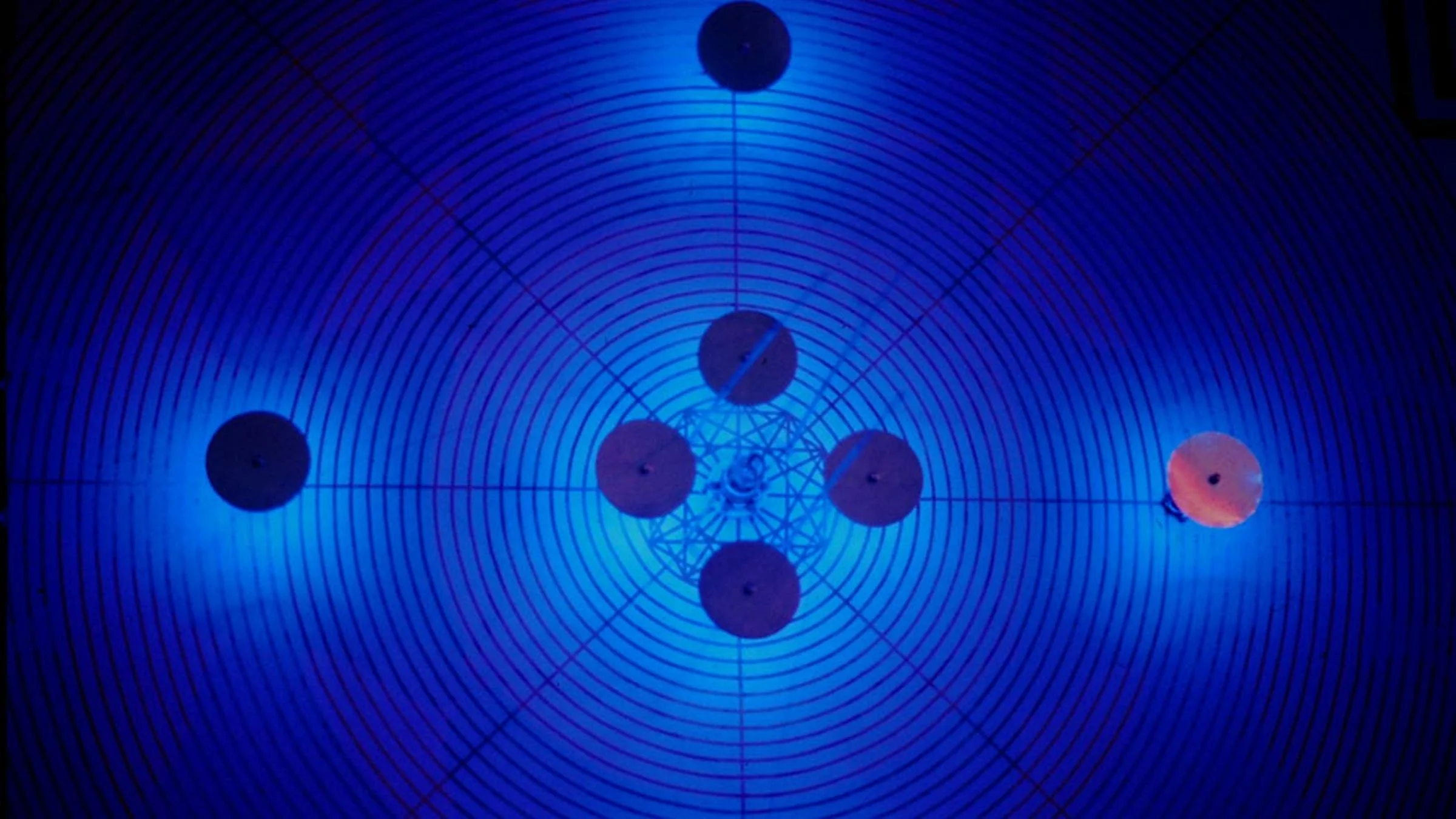
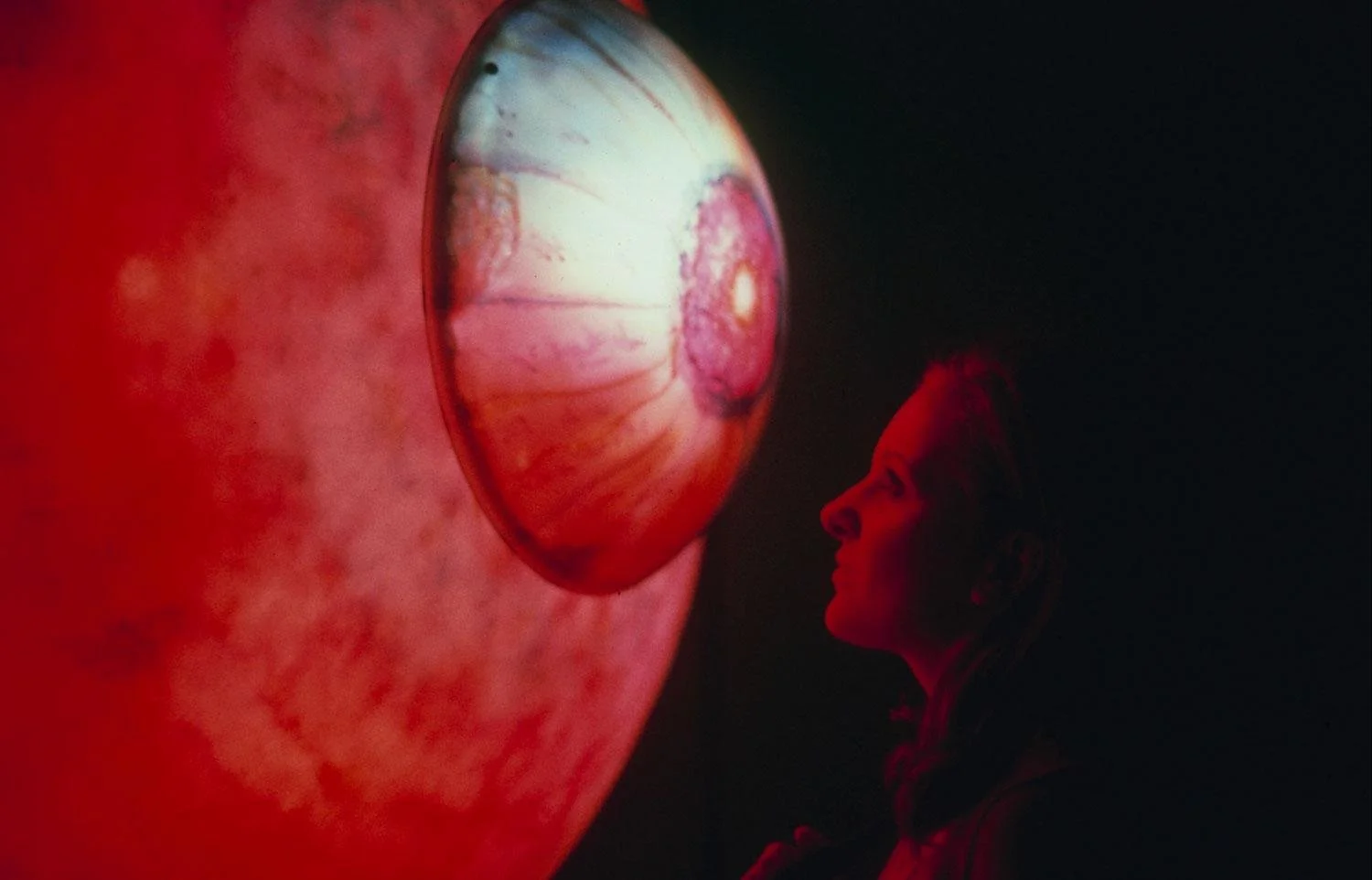
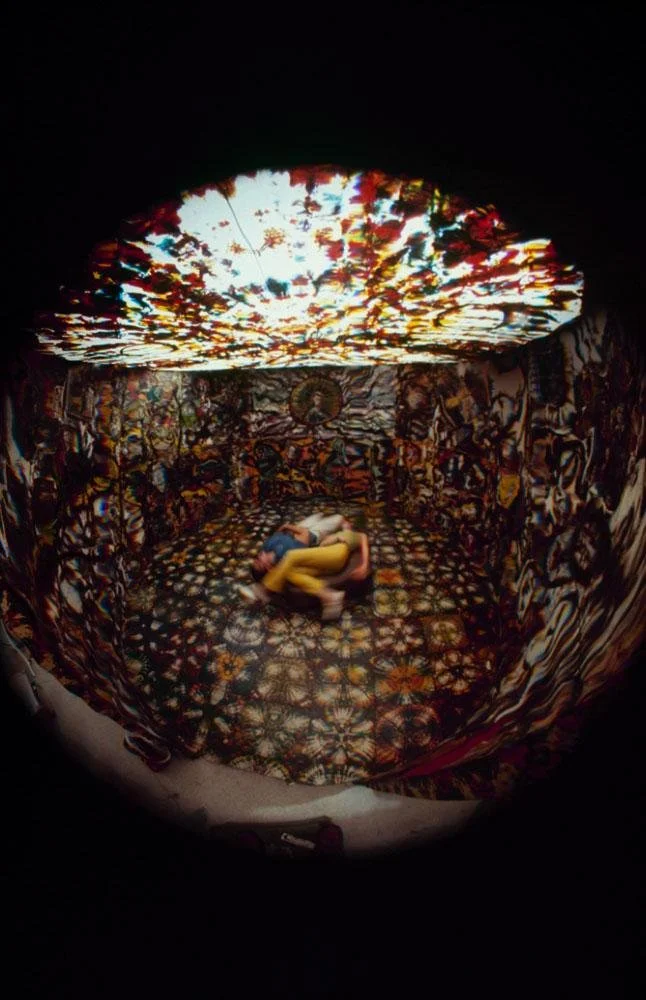
Above: Installation views of USCO's Be-In at the Riverside Museum, New York, 1966, featuring experimental environments incorporating projected imagery, light, and immersive sensory effects. Photographs: Yale Joel / The LIFE Picture Collection / Getty Images.
BASF: Your research into USCO and the experimental communities of the 1960s reveals some fascinating connections to Bobby's own influences, including Ram Dass and Be Here Now. Can you tell us more about those connections?
PR: One particularly interesting connection is Be Here Now by Ram Dass, which I understand was influential to Bobby. Richard Alpert, who later changed his name to Ram Dass, was part of the Millbrook circle that intersected with USCO.
Barbara and Steve Durkee, who were important participants in USCO, later went west and established the Lama Foundation in New Mexico. Steve encouraged Ram Dass to turn his lectures into a book, and that became Be Here Now. They also contributed drawings to the book. It's an example of how interconnected those networks were, and how ideas moved between art, spirituality, and communal experimentation.
My research with Devin Lander has also examined the collaboration between USCO and the Castalia Foundation, the Millbrook-based experimental community associated with Timothy Leary. . We looked closely at a series of public workshops in New York in the spring of 1965, where USCO contributed performances. The history is often retold in ways that blur together different events, so part of our work has been to disentangle those stories and document what actually happened.
I'm fascinated by those relationships between people, places, and ideas. There's always another connection to discover. That curiosity is one of the things that keeps bringing me back to the research—and one reason Bobby's work feels so meaningful to me.
BASF: How did you come to curate Bobby Anspach's exhibition at the Toledo Museum of Art? Did you see a connection between his practice and your research?
PR: It really feels like kismet that I'm working on Bobby's exhibition, given my background and interests. When I joined the Toledo Museum of Art, there was already a commitment to do an exhibition on Bobby, and I was told I'd be its curator. Exhibitions can come about in many different ways, but the moment I began reading about Bobby and looking at his work, I saw strong connections to my USCO research.
I think Jane and Bob felt that connection, too, when we started corresponding and getting to know one another. It's also interesting that Bobby had been working in Newburgh, New York, not far from the area around Garnerville and Millbrook that figures so prominently in my research into the 1960s. There are these unexpected geographic and conceptual resonances between the projects.
What feels especially meaningful is the shared interest in interconnectedness, consciousness, and experiences that might change how we relate to the world. USCO used the motto “We are all one,” which came from Meher Baba. I hear a closely related idea in Bobby's work.
As I began developing the exhibition, I understood my role primarily as creating the right conditions for visitors to encounter Bobby's sculptures—his Place for Continuous Eye Contact works—in an accessible and positive way within a museum. These are not always straightforward works to present in an institutional setting. I wanted people to feel open and comfortable enough to experience them, and I wanted Bobby's own voice to be central.
This wasn't primarily an archival exhibition that tried to reconstruct every detail of his biography, although I would love to see more scholarship of that kind. I hope this exhibition generates that interest. My focus was on the artworks themselves, the visitor's journey, and how to honor Bobby's intentions through the exhibition experience.
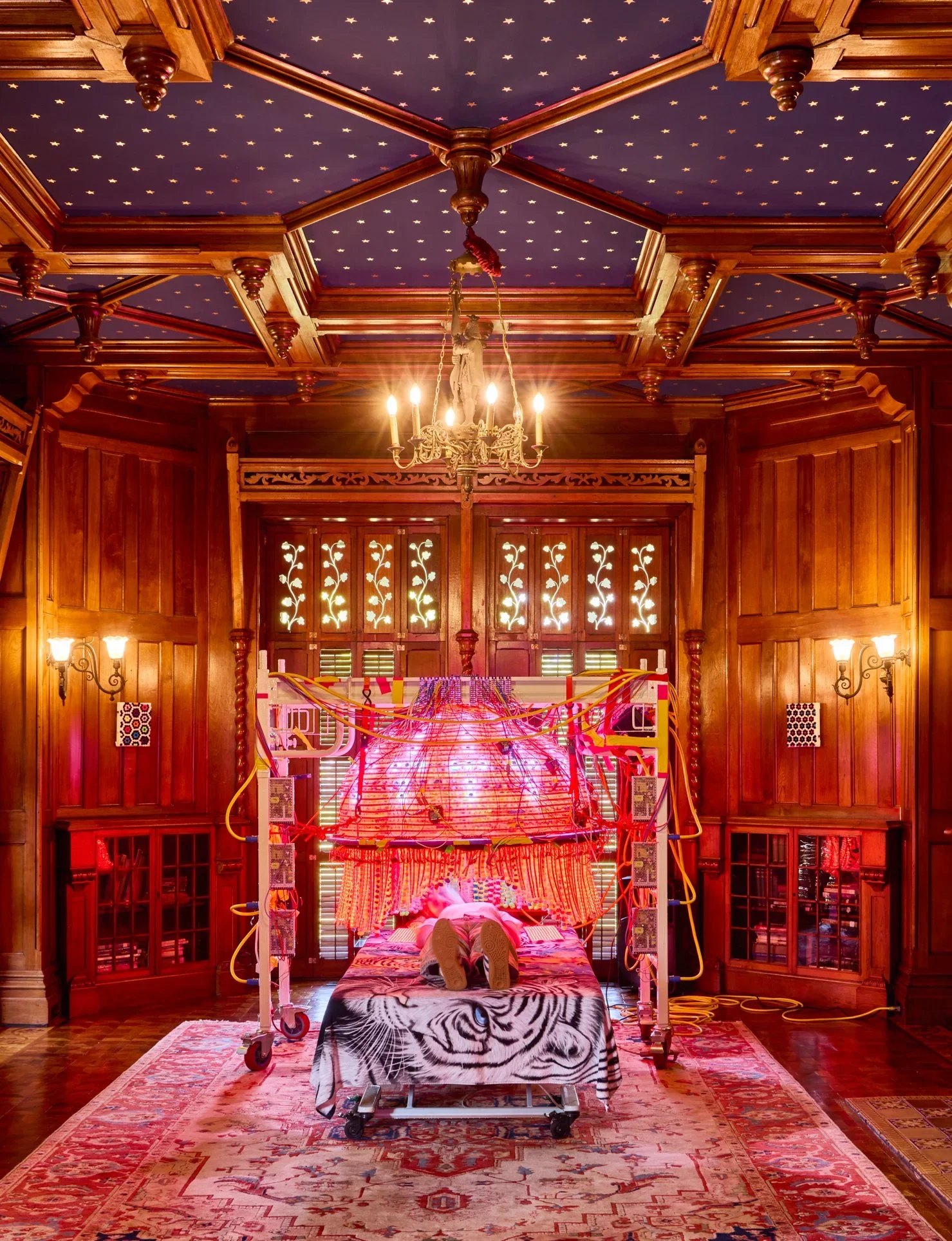
Place for Continuous Eye Contact at Everything Must Change, Newport Museum of Art, 2025
BASF: Do you remember your first encounter with Bobby's work? What was your initial impression?
PR: The first time I experienced Bobby's work was at the Newport Art Museum, in August 2025, shortly after I started at Toledo. Paula encouraged me to come see the exhibition there.
I wasn't deeply familiar with his work before that visit, and I remember entering the experience feeling very open-minded. I was excited and engaged by the sculptures, and I also felt that perhaps I was exactly the kind of person who should be working on this exhibition, because it aligned so closely with my interests.
As I learned more about Bobby, I was struck by the singularity of his vision. His life and his art seem so interconnected. Of course, an artist's experiences often inform their work, but with Bobby, the connection feels especially holistic. You can't easily separate the sculptures from the person who made them and the ideas that motivated him.
There is a kind of utopianism in his work, but I don't think Bobby was naive about the world. He was very aware of the world he lived in. The impulse to bring people together and emphasize our interconnectedness feels deeply grounded. It's a way of looking at the world that resonates with me personally, and with so much of the work I've done on USCO and other artists.
BASF: What do you hope visitors take away from Losing Ourselves Together?
Paige: Above all, I hope they have a meaningful experience. We've worked hard to create the circumstances for that, while recognizing that everyone will respond differently.
We often describe Bobby's sculptures as immersive, but I think it's important to recognize that they're performative, too. It's almost strange to call someone a “viewer,” because this isn't just something you view. As a visitor or participant, you activate the work. You become part of it. The work exists because of your participation.
That can be incredibly meaningful. The possibility of a transformative art experience—of being able to sit for even a few minutes and allow your mind to move differently—feels especially valuable right now.
I hope the exhibition also helps establish what I believe will be an enduring legacy for Bobby, and encourages other people and institutions to discover his work and want to experience it themselves.
There were two guiding ideas in my approach: first, to create the best possible circumstances for someone to experience the sculptures in a way that honors Bobby's intentions; and second, to put Bobby's voice front and center. I wanted visitors to leave thinking about the things he cared so deeply about, including the state of our planet, climate change, and our relationship with the environment.
BASF: How did those intentions shape the exhibition's design and the visitor's journey?
PR: In an ideal world, it would be wonderful if someone could simply come upon one of Bobby's sculptures, enter it, and experience it without needing an explanation. Bobby himself understood how difficult the work is to describe. You can talk about the shifting perception, the light, the patterns, or the sound, but words don't really contain the experience. It's so individual.
In a museum, though, you also have a responsibility to help visitors understand what to expect. We wanted people to enter with openness and trust rather than uncertainty. That's why I began thinking about the exhibition as a journey.
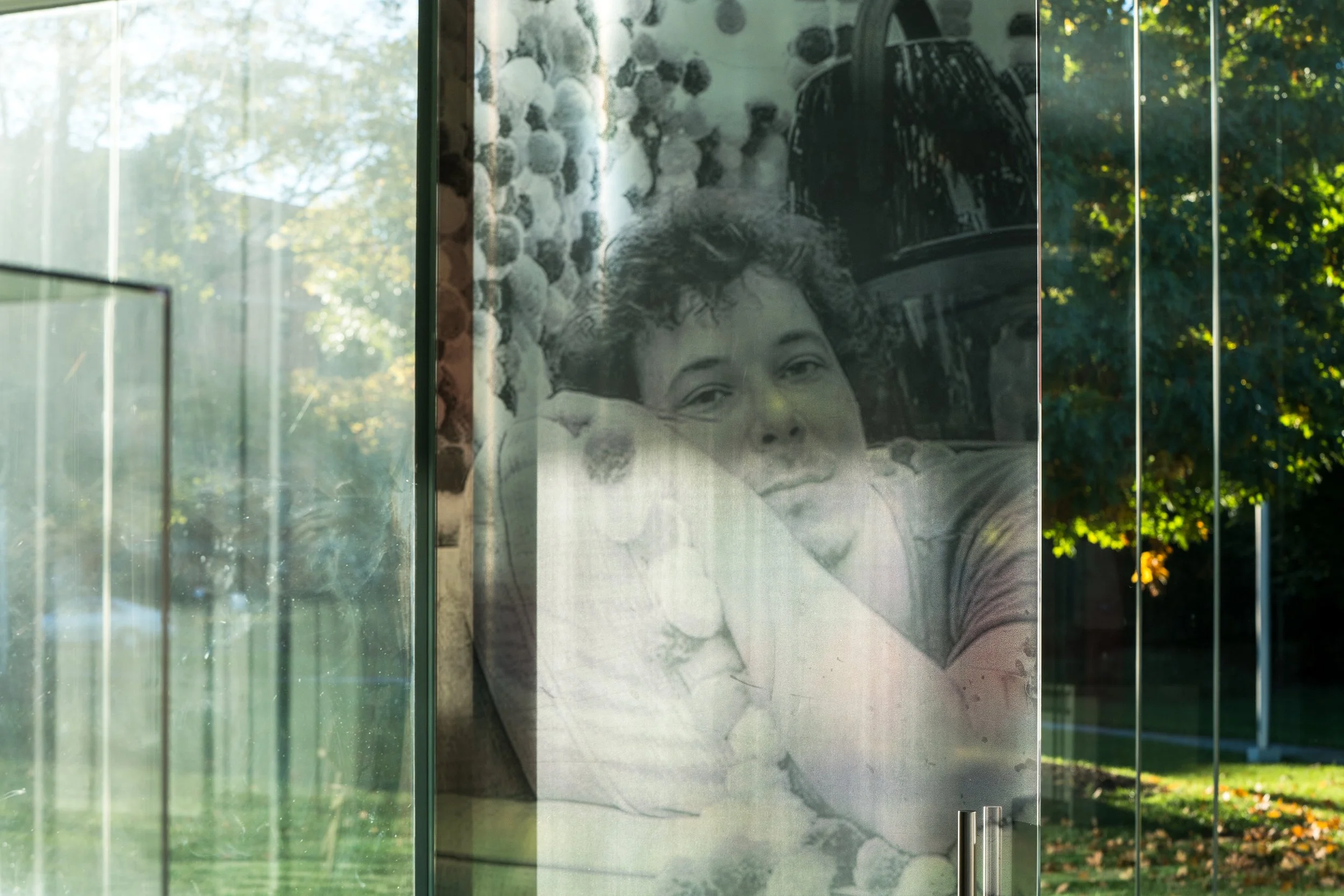
Visitors begin in an orientation room, where they can watch Julia Barrett-Mitchell's documentary. It's an extraordinary introduction because Bobby appears in his own image and speaks in his own words. You learn about the ideas he was developing, how they informed his art, and what you might encounter inside the sculptures.
From there, visitors move into the main exhibition space and experience the machines. We have guides for each sculpture, and there's a sense of being gently supported through the experience without having it prescribed for you.
Afterward, visitors can enter a reflection room. I wanted them to have somewhere to process their thoughts and emotions, because Bobby's work can evoke very different responses. It can also simply be a place of respite. The exhibition is in our beautiful glass pavilion, and from the reflection room you can look outside. Bringing that view of the natural world into the experience felt essential, given how important nature was to Bobby.
We also highlight books and ideas that inspired him. For visitors who want to know more, those references provide another way into his interests, his mission, and the larger contexts of spiritual practice and art history. That's probably my own curiosity coming through—I love connecting the dots and giving people a path to keep learning.
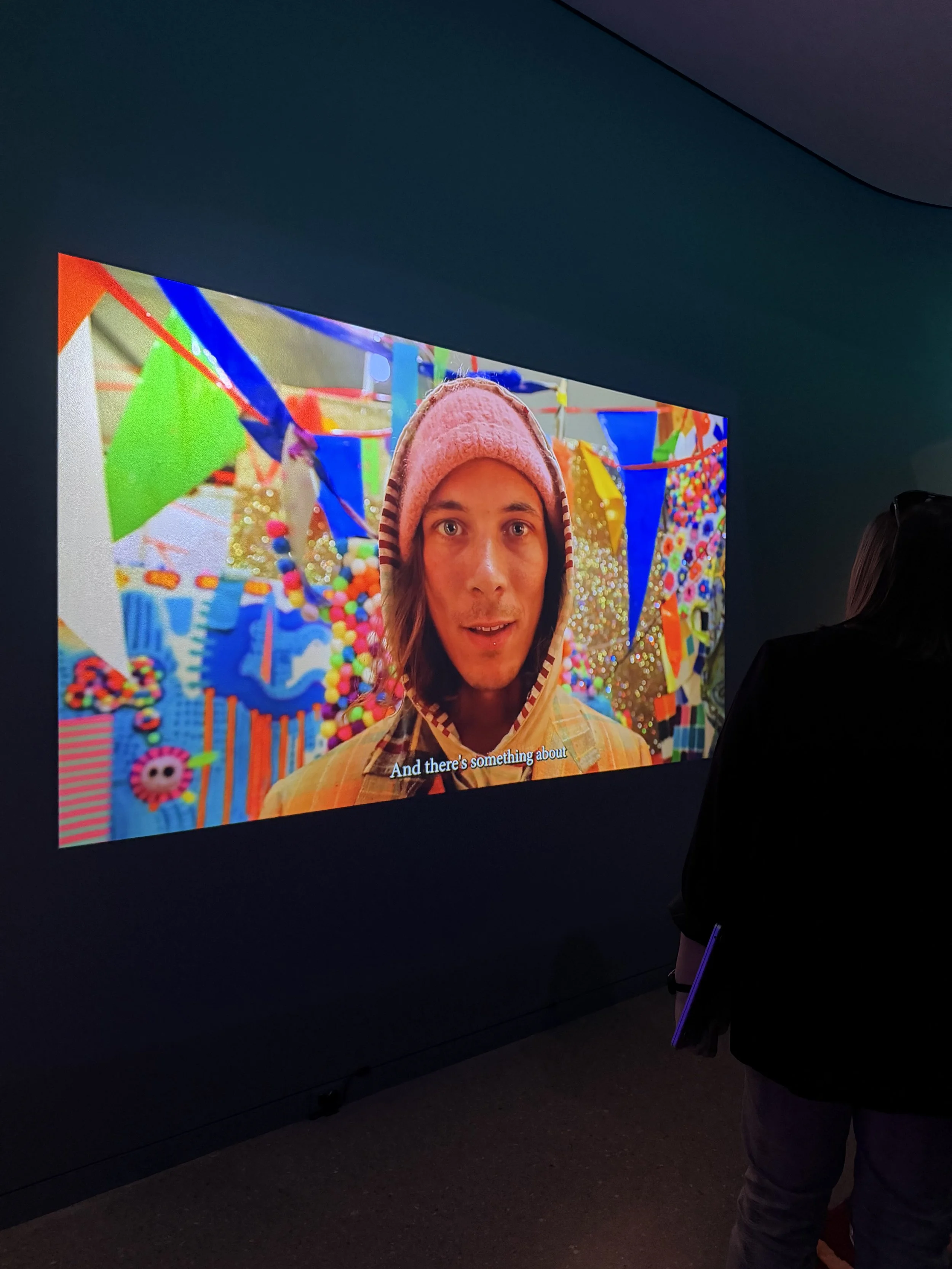
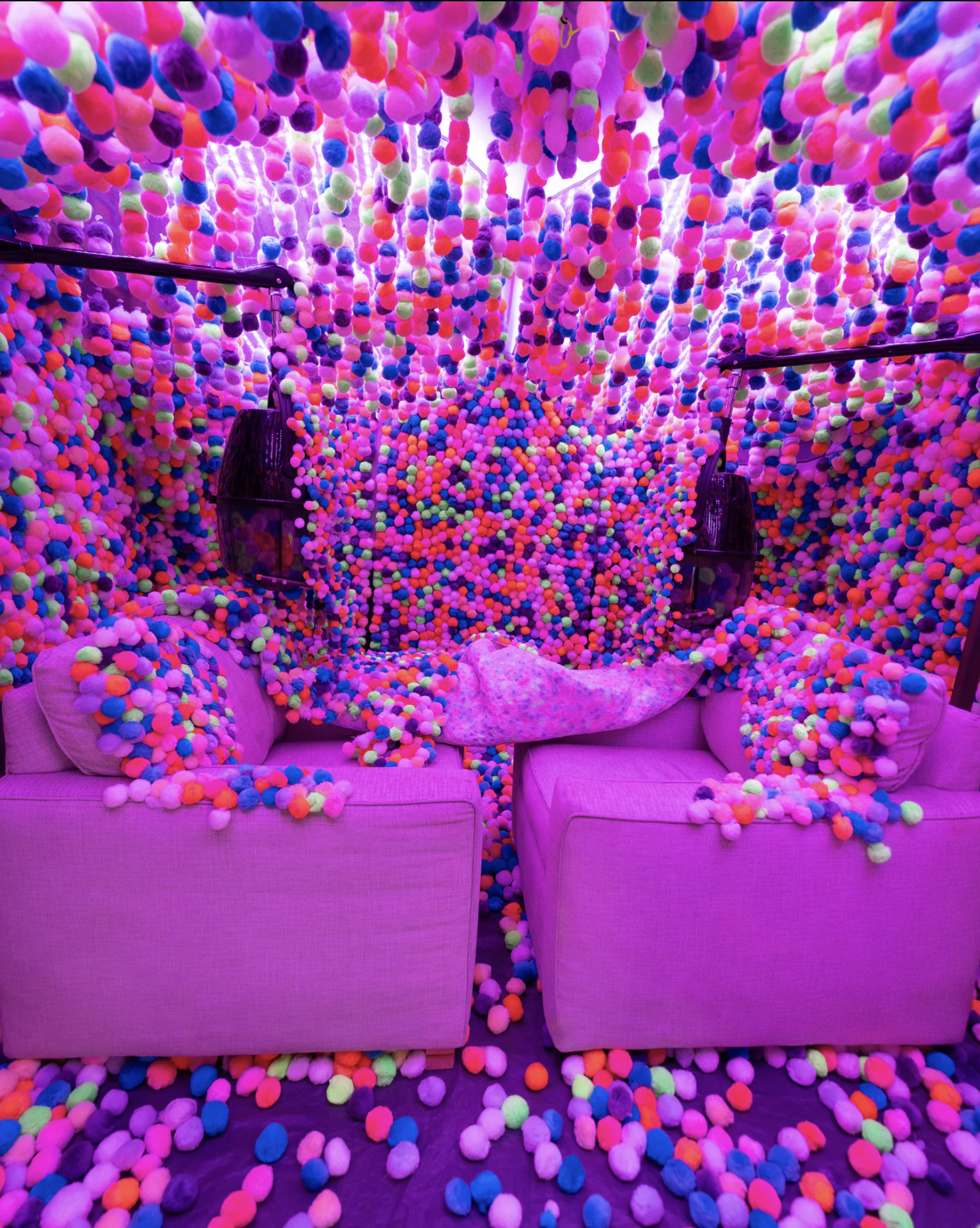
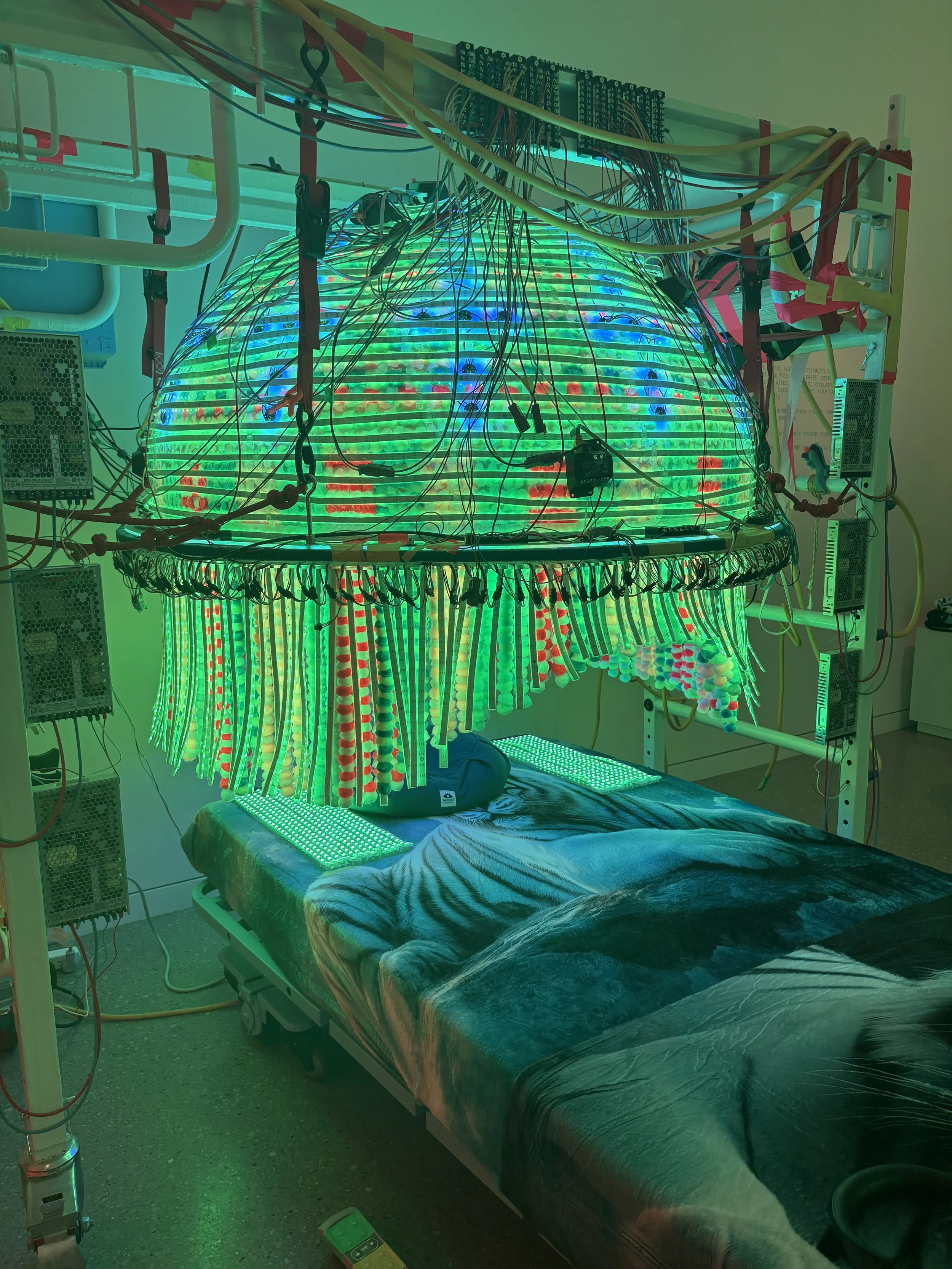
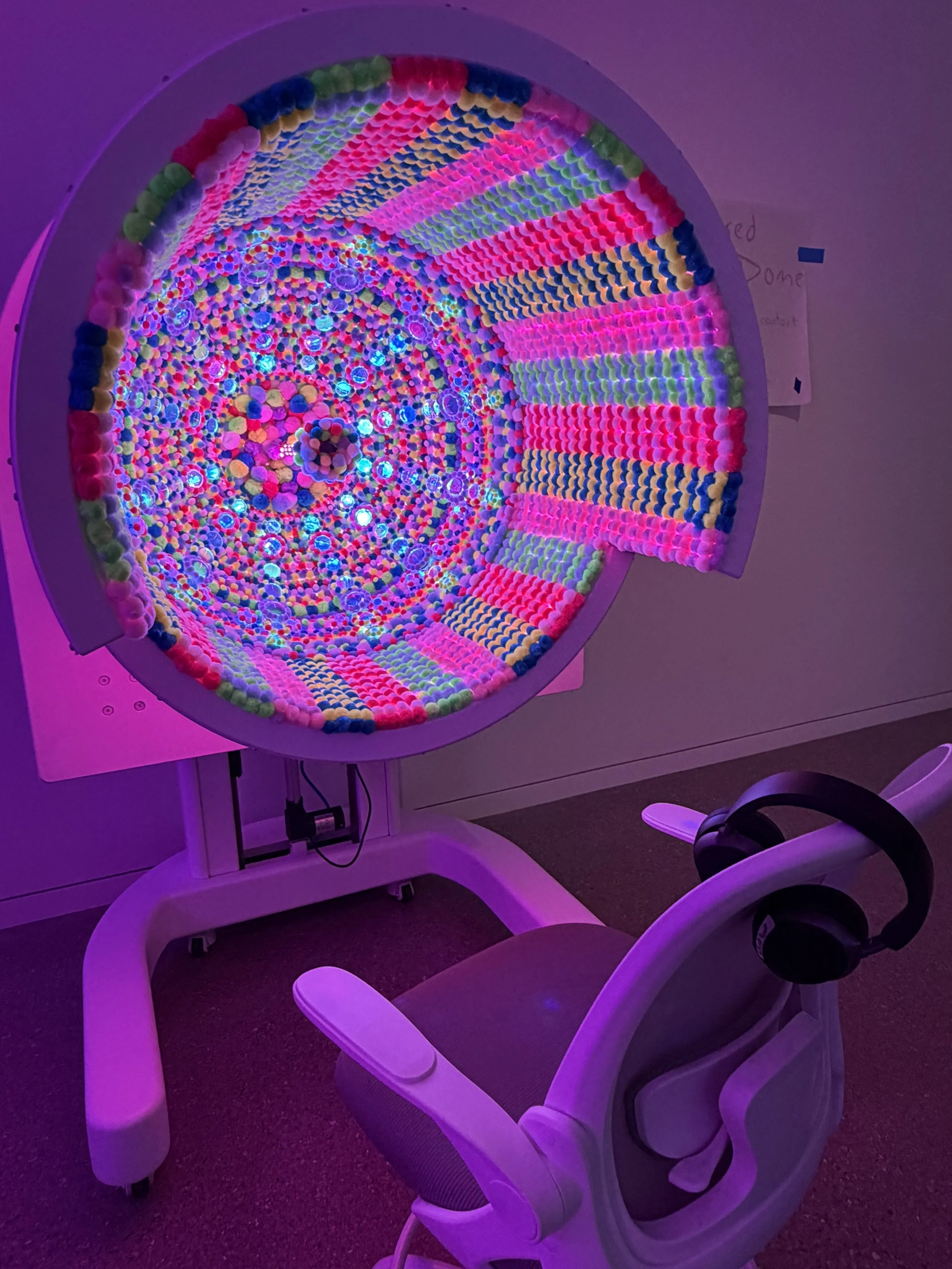
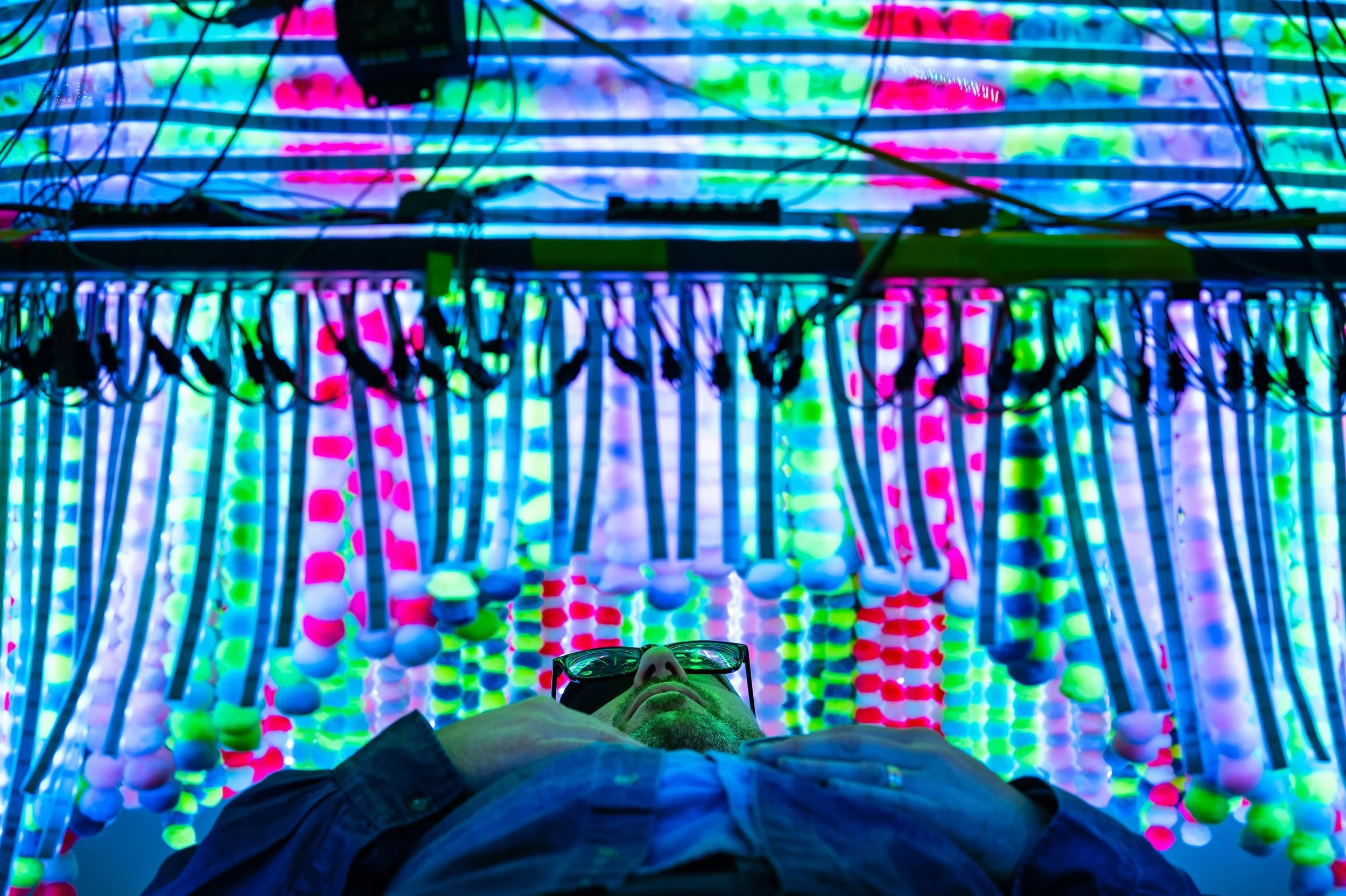
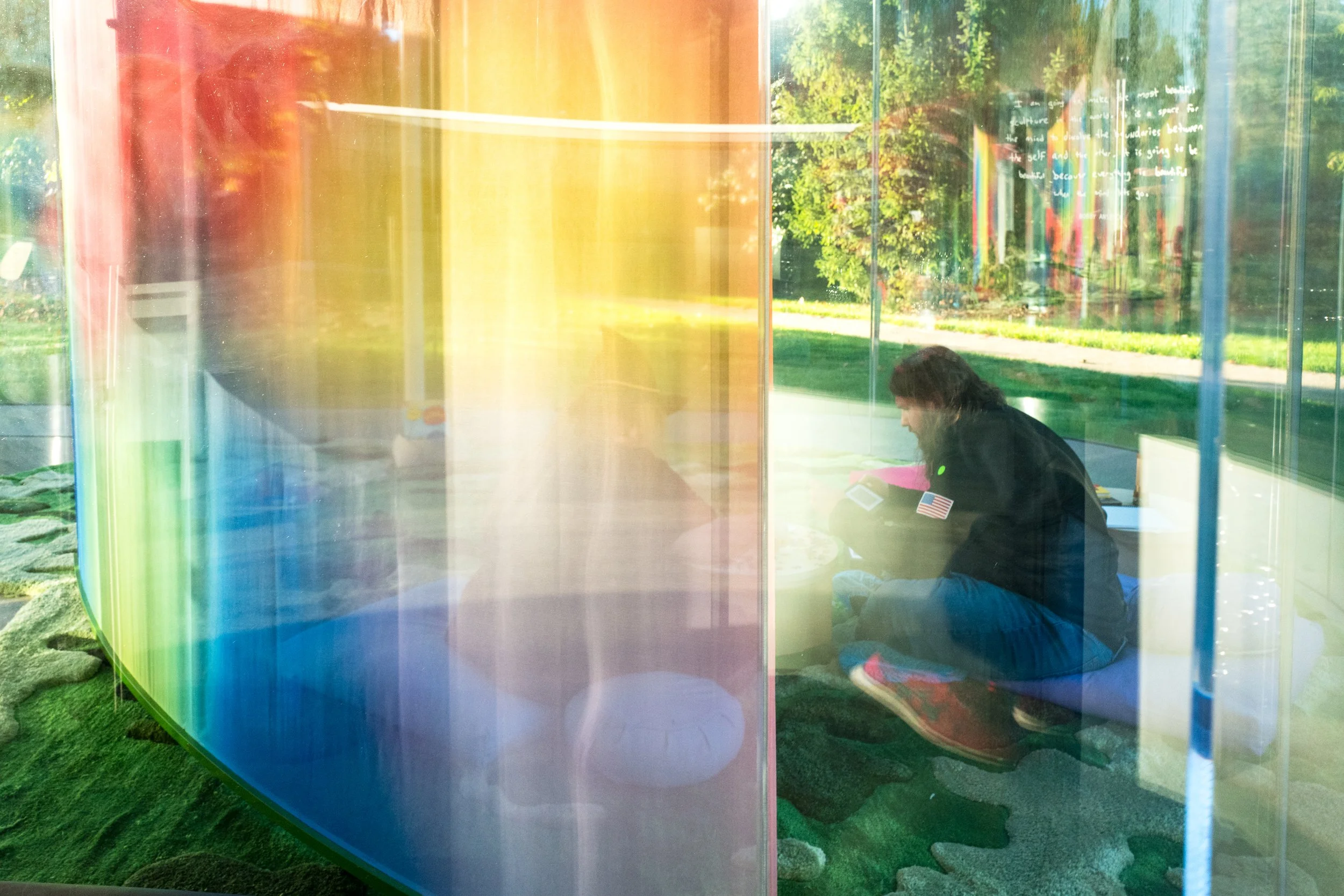
Above, from left to right, top to bottom: The Beautiful Nothing documentary film by Julia Barrett-Mitchell; Place for Continuous Eye Contact (tent); Place for Continuous Eye Contact (single-participant installation); accessible Place for Continuous Eye Contact; interior view of Place for Continuous Eye Contact; and the Reflection Room. Installation views from Losing Ourselves Together: The Art of Bobby Anspach, Toledo Museum of Art, 2026.
BASF: What does it mean to bring Bobby's work back to Toledo, his hometown?
PR: I think there's something very touching about bringing Bobby's work home. I'm curious to see how the community continues to respond.
Of course, I hope people experience a moment of calm, or meditative bliss, or a feeling of connection to something larger—many of the things Bobby spoke about. But I also hope it can be inspirational, particularly for younger visitors. To see someone from their hometown go out into the world, become an artist, and make work that is so singular and meaningful—that matters, too.
BASF: Beyond this exhibition, what interests and experiences shape the way you approach your work?
PR: I feel fortunate to have a profession that allows me to incorporate so many of my interests. I love music, film, art, literature—really any creative endeavor. Cultural history is what drives so much of my curiosity: what people make, how they live, and how their lives and relationships shape the things they create.
Outside work, I spend a lot of time in nature. I love hiking, backpacking, and camping. Sometimes I think the greatest art is simply what exists in the natural world, and we're lucky to spend time with it.
My connection to Bobby's work is personal in another way, too. My father passed away around the time Bobby died. Experiencing grief in a way I hadn't before was difficult, and it took time to recalibrate. It made me think differently about the preciousness of life, which is something Bobby spoke about so often. I think that experience is part of why his work resonates with me.
I'm also drawn to meditation and yoga, and to practices that encourage us to slow down and pay attention. Those interests sit naturally alongside the questions I explore through art.
FURTHER READING & RESOURCES
Panel discussion, Hudson River Valley Institute, March 27, 2024.
Paige Rozanski, New York History, vol. 105, no. 2 (Winter 2024–2025), pp. 241–273.
Devin Lander and Paige Rozanski, The Hudson River Valley Review, vol. 41, no. 1 (Autumn 2024), pp. 2–29.