A Conversation with
Bobby McElver
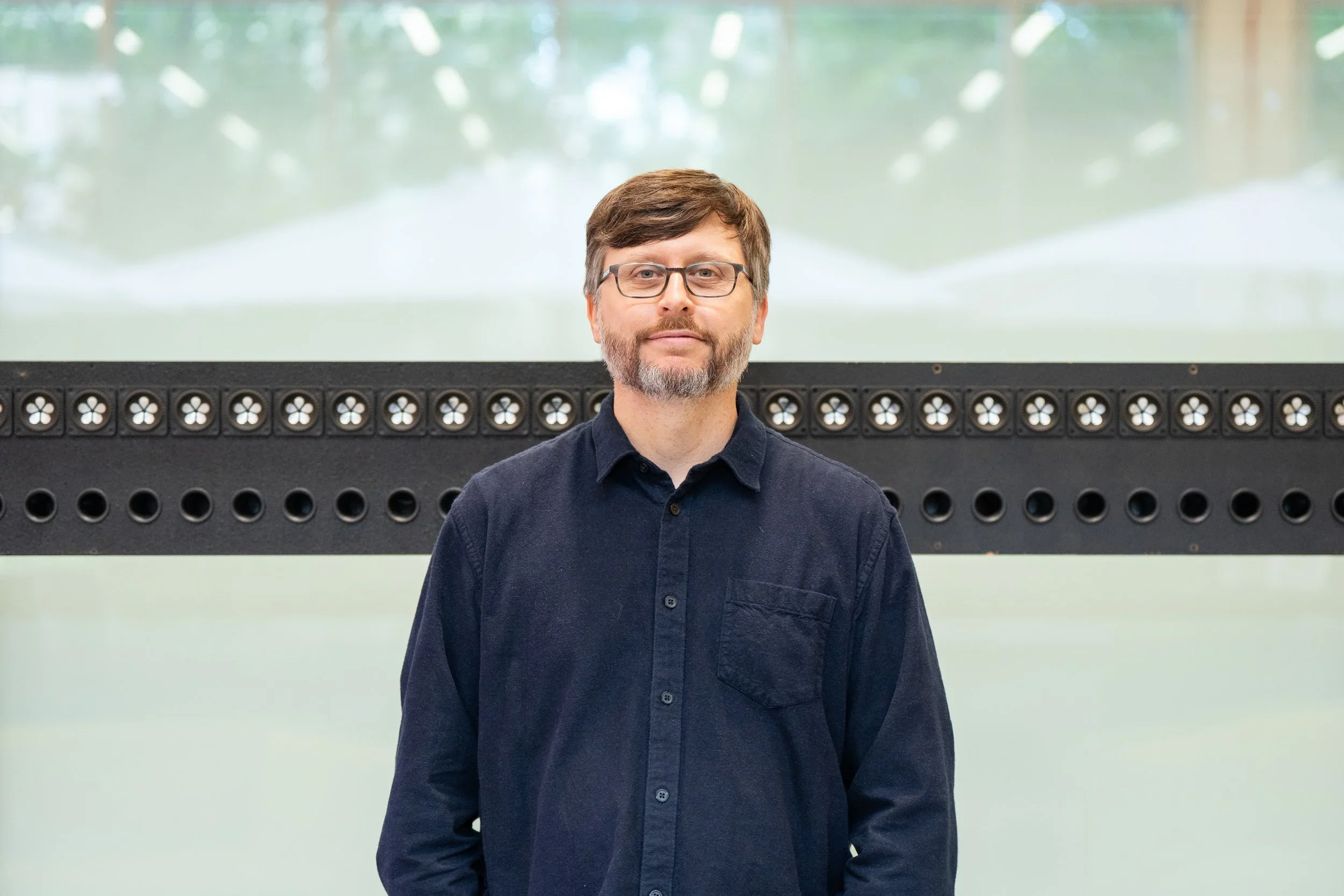
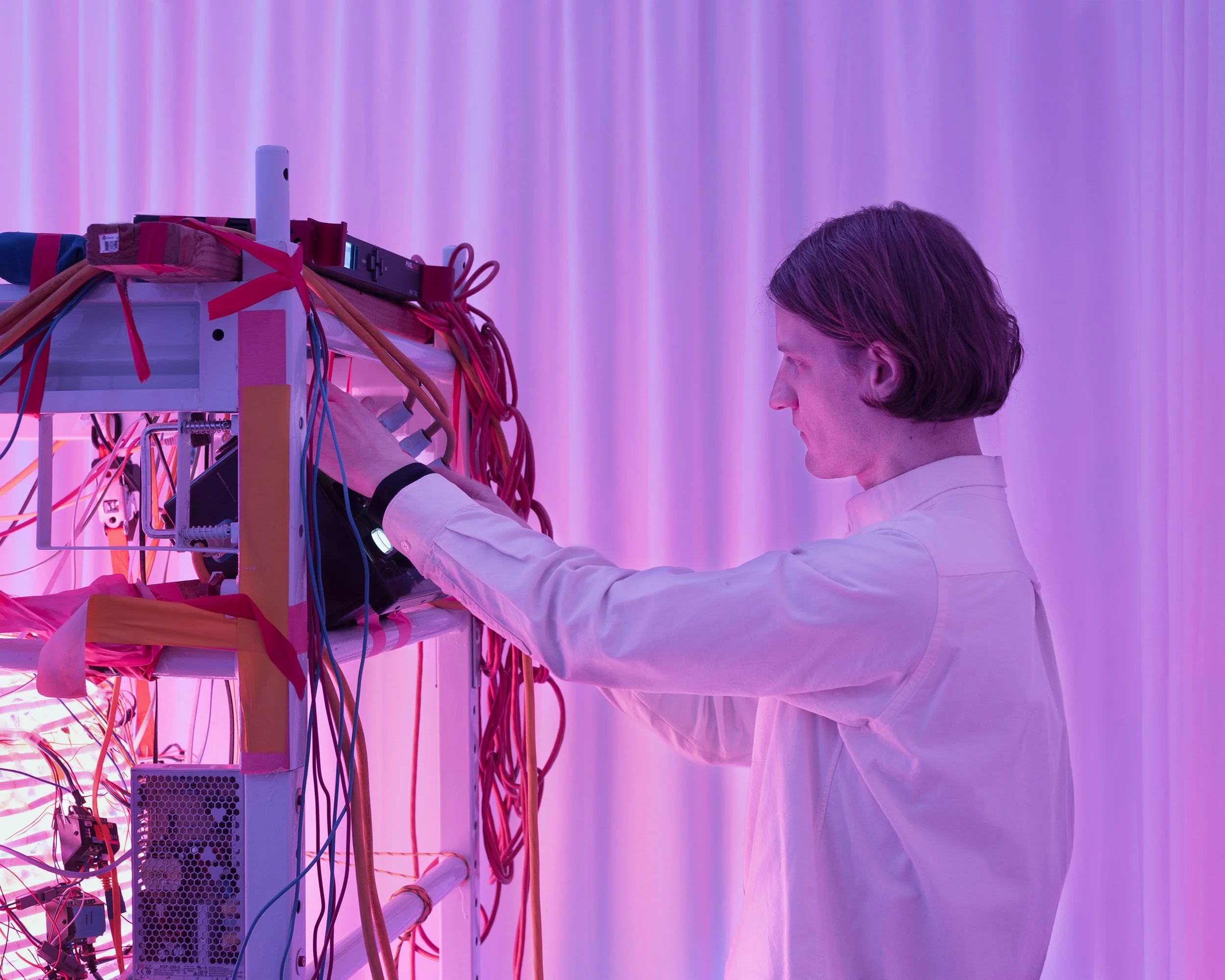
As one of the inaugural recipients of the Bobby Anspach Studios Foundation's $50,000 artist grant, Bobby McElver is expanding the possibilities of what sound can do. Based in Southern California, McElver works at the intersection of art and engineering, developing new spatial audio technologies that allow audiences to experience sound in ways conventional systems cannot. Alongside his artistic practice, he serves as Associate Professor and Head of the MFA in Sound Design at the University of California San Diego, where research and experimentation continue to inform his work.
The foundation selected McElver in support of The Known and Unknown Mind, an interdisciplinary project that combines immersive sound with neuroscience to explore consciousness through audience participation. In the conversation that follows, Bobby reflects on the evolution of his practice, the ideas that continue to shape his work, and the ambitious new project the foundation is helping bring to life.
Q: Before we talk about your work, we’d love to begin with you. What first sparked your curiosity about the world in a way that eventually led you to become an artist?
BM: From an early age I was very curious about time. I couldn’t wrap my head around why the experience of “right now” would jump from moment to moment. As a kid, I would experiment with this by sitting and looking at something for extended periods of time, trying to examine or extend the present moment. Sometimes I would sit on a rock and watch the ocean for several hours. There’s a picture of me doing this – I am probably 8 years old. Later, as a teenager, I would sit on a city bench and watch the stoplights change for hours. People would come up and ask if I was OK. I never did drugs, though people would tell me that’s the kind of activity people did on drugs. And I hadn’t been exposed to the long history of meditation practice, so I was just sort of bumbling around trying to figure it out myself. I fell in love with time-based arts like music and theatre and performance art, which play with your senses over a duration of time. My mother was a visual artist and my father was an engineer in early computers. So my home was filled with clay and paint and hand-me-down computers. I played with all of it. I had a cassette recorder and would capture sounds and environments and make sonic collages, curious about capturing time on tape and then manipulating it. I taught myself various musical instruments and played in bands. I sound designed for theatre performances. I spent a lot of time noticing how sound affects what a room or a moment feels like. I think during those early long durational experiences I was also losing my sense of self to some degree. I had a feeling that if I wanted to I could just stay in that state indefinitely and leave the world behind, but there was a strong part of me that wanted to return to the world and be helpful while I’m here. Expressing what is difficult to put into words felt important and sound became the medium. In another life I might have been a scientist or philosopher, but in this one I became an artist.
Q: Your career began in experimental theatre, including more than a decade touring internationally with The Wooster Group, before expanding into installation and spatial audio. Looking back, what first drew you toward immersive experiences, and how did those experiences shape the artist you are today?
BM: I think you could say that every Wooster Group performance is an immersive experience. Even though you are typically seated in a row of seats looking at performers on a stage, your senses are guaranteed to be overwhelmed by complexity and layers, especially sonically and spatially. Without even knowing it, I was being trained on how to design impactful immersive experiences. Many of my favorite moments were creating the sonic spaces that happened in-between moments of dialogue or action. I loved designing an environment that could be a place for reflection and/or emotion. At times the soundscape might even subvert what was happening on stage, and that was not only allowed but encouraged. You could really try anything in that environment. Wooster also taught me to think like a holistic artist. One of the most impactful things I learned from day one was to break out of my speciality and consider the entire experience, dreaming across disciplines. My area of expertise was sound, but my role was to be a company member and co-create the experience with the group. The whole was always more important than your part, and context was king; everything affects everything else. We all needed to be dramaturgs and keep the entire experience in the front of our mind. Anyone could have an idea and we would try it. The lighting person could have an idea for sound or an actor could have an idea for lighting. The best idea wins, period. This trained me to feel comfortable thinking holistically as an artist. There was also a lot of pressure to innovate. Liz (Elizabeth LeCompte) told me on my first day that I should be able to send sound to any speaker in the room at a moment’s notice. This was not easy back then! I taught myself Max/MSP and built complex routing systems to use with analog mixing boards. And because I built it all myself, I could also experiment with it. Being a company member meant I worked 40 hours a week and had keys to the building. I could go in at night and iterate if I wanted to. This meant I had an extraordinary amount of time to experiment. I grew more and more interested in space and spatial audio as another dimension to play with, and eventually it became the center of my work.
Q: Sound has become the foundation of your practice. What is it about sound that continues to fascinate you, and what can it communicate that other artistic mediums cannot?
BM: Sound is how I play with time, emotion, and memory. It’s invisible, yet has a direct line to emotion. It is a medium that can instantly transport someone’s physiological or emotional state within milliseconds. A sound signal reaches the emotional center of the brain quicker than the rational cortex can create a story about what’s happening. So in some ways it’s a direct line to feeling. On an intuitive level, I’ve been using sound and music to shift brain states my whole life, but in recent years I started learning more precisely about what’s happening in the brain. So while my intuition still drives a lot of my art making process, I also take into consideration things like how the thalamus, amygdala, and hypothalamus interact with the auditory cortex, for example. When sound is more organized, like music, it sticks in memory. This allows a sound experience to be both durational in real-time while also referring back to an earlier (possibly emotional) moment within a piece. I am fascinated with the toggling between the experience of noticing the present moment, shifting when faced with novelty, getting in a flow state while listening, and suddenly being in the present moment again anticipating something like a musical change. The edge of that anticipation is an exciting place to create. In some ways sound is also the closest sensation to touch, and can be an incredibly intimate artistic medium. The work I’m doing with wave field synthesis and “sound holograms” takes this to another level.
Q: Looking back across your body of work, is there a project that fundamentally changed the way you think about sound, perception, or the relationship between artist and audience? What made it such a turning point?
BM: I was working on an experimental theatrical production called AFTER (with Andrew Schneider), which was in part a story about hallucinations. And we had a rather audacious goal. We wanted to make the audience hallucinate. Not watch a character experience hallucinations, but experience it themselves. Because the difference between making a piece about hallucinations and making the audience hallucinate is all the difference in the world. During a 20-minute complete visual deprivation blackout, sound moved around the audience in impossible ways, using hundreds of speakers and a hyperprecise sound spatialization technique called Wave Field Synthesis to create “sound holograms.” Sounds would fly around the physical space and even whisper in a single ear. As neural noise amplified in their brains from lack of visual input, the “sound holograms” caused many in the audience to experience hallucinations and some even had moments of ego death. The impact on the audience who experienced this was powerful, with many utterly astonished. After that show I realized I would spend the rest of my life working with these tools to create transcendent experiences.
Q: Your work often centers on what you call “sound holograms.” For someone encountering the idea for the first time, what is a sound hologram, and what experiences does it make possible that traditional sound cannot?
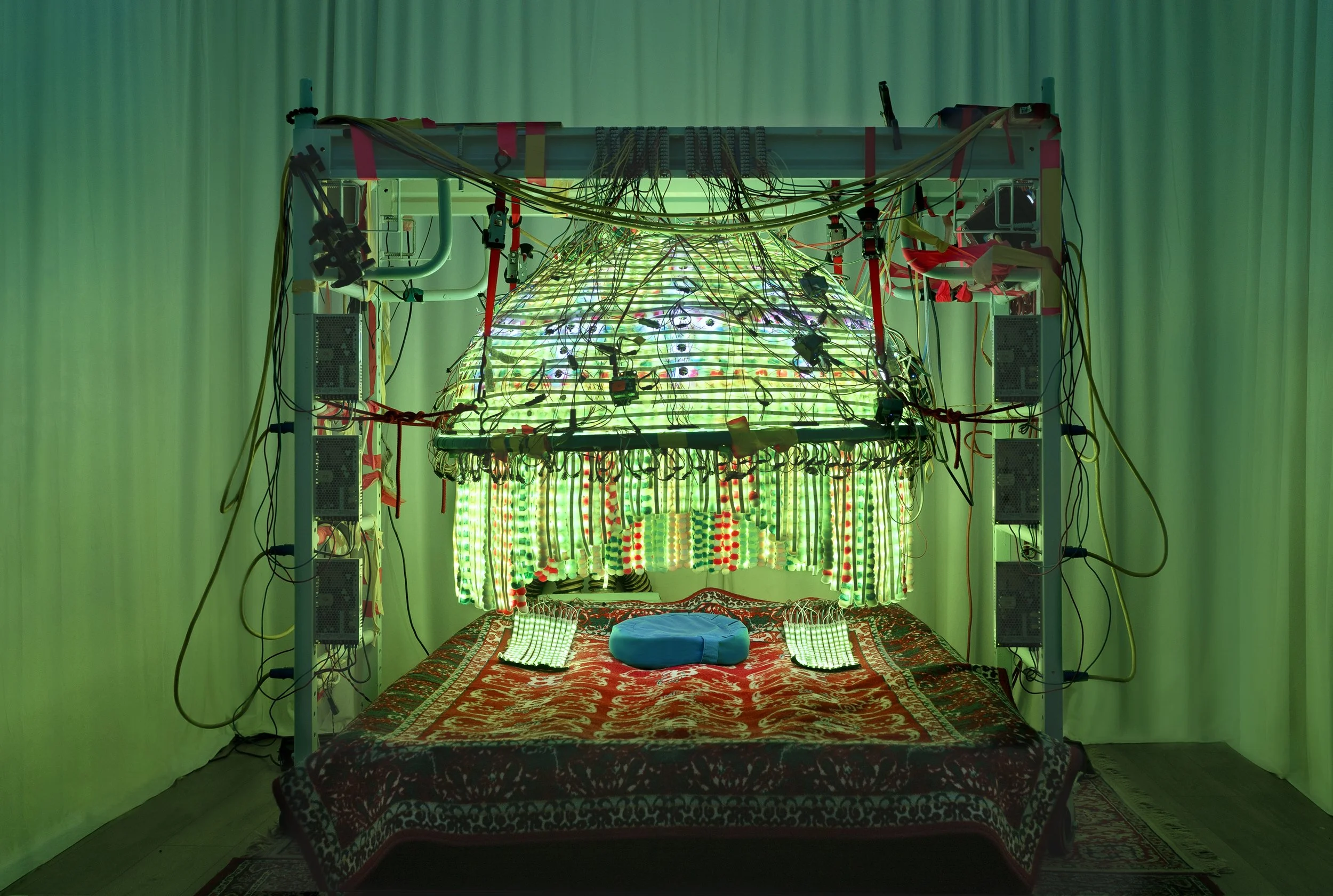
BM: I use a spatial audio rendering technique called Wave Field Synthesis, which allows me to place sound anywhere in physical space within a room, as precisely as whispering in a single ear from across the room. I build custom speaker arrays with hundreds of tiny speakers, all with individual channels and processing, and they work together to create accurate wavefronts at a particular point in space. I call the result “sound holograms” because that’s the easiest way to convey the experience. The system creates a small area of sound that you can walk in and out of, or that flies past your ear. You can literally poke your head in and out of the sound even though the speakers are against a wall across the room. Technically, it should be called a “holophone” but I use “hologram” because people more easily know what I’m talking about. The technical term is actually “focused sources.” In order to achieve this you need a lot of speakers, very close together. I build these systems by hand because you can’t buy or rent something like this. You have to build it yourself. Most people don’t believe me that it works until I show them. Then once they hear it they don’t want to leave because it’s so magical!
One of the most impactful uses of this technology is to have sound reach people in intimately close proximity. A quiet sound can float up to a single person and only they can hear it. A voice can realistically take shape in front of them and walk around. A piece of music can fly across the room and then slowly go in one ear and out another. For most sound systems, the goal is to have everyone hear the same thing at the same volume at the same time. What I am doing flips all of that upside down. Different people hear different sounds at the same time in the same room. The more common spherical spatial audio systems, which can have sound travel around in 360º, still can’t move within the room and do things like come up close to a single person. Wave Field Synthesis can create truly sculptural three-dimensionality that people can poke their head into.
Q: The Known and Unknown Mind brings together your work with neuroscientist Ying Wu and immersive media artist Tommy Sharkey. How did this collaboration come together, and what is each collaborator bringing to the project?
BM: Ying reached out to me years ago when she heard about my work with spatial audio and hallucinations. She does research on how immersive environments, like virtual reality, can shift brain states in ways comparable to meditation or psychedelic therapies. We both got very excited about the potential of three-dimensional sound, specifically the hyper-precision of wave field synthesis, and how it could broaden these experiences and research. She’s one of those rare scientists who is interested in both art and scientific research. Far too often in art-science collaborations the artists will incorporate scientific research solely to be in service of their art, or the scientists will participate in art projects with a narrow goal of science communication, and there aren't a lot of overlapping goals or research interests. Ying is doing scientific research that directly engages art and I am an artist that’s interested in contributing to scientific research. We have different ways of approaching questions, but we share a lot of the same questions. Ying also introduced me to Tommy, who is an innovative visual designer and developer with experience working across neuroscience and art.
Ying brings a wealth of knowledge about the brain to this project. On a technical level she knows how to measure real-time brain activity, and which areas of the brain will be useful to monitor for various goals, like knowing when a person’s internal monologue rests. But she is also guiding me towards creating the types of experiences that can be more successfully measured and studied. Monitoring and enhancing altered states of consciousness related to self-transcendence may have more success than trying to “instill awe”, for example. She can point to research papers and weaknesses in other projects so we avoid pitfalls. The biofeedback in this project will be extremely considered and thoughtful.
Tommy is crafting the visual mechanics that will respond dynamically to brain states. He has a computer science background and specializes in human-centered design. He is creating immersive natural scenes that become more rich and beautiful depending on a person’s state and how we might want to affect them.
Additionally, we are all in conversation about the dramaturgical questions of the piece. What is the difference between immersion in the natural world vs connection to the natural world? How is agency and embodiment functioning in the work? For a solo experience, how can each audience member feel connected to others who have experienced it? It’s a rich collaboration and I am very grateful to get to work with them.
Q: The installation invites audiences to become active participants whose own attention, reflections, and brain activity help shape the experience. Why is that level of participation important to you, and what possibilities does it open up for the work?
BM: I want to make work that needs the audience to be there for it to exist. I love recorded music and films and other distributed mediums, but I am interested in making art experiences that only exist in the present moment and only if you are there. It’s for you. It’s not for distribution. The version of the piece that happens when you are experiencing it will never happen the same way again and there’s something beautiful about that to me. And what’s unique for you is not arbitrary. It’s not just a real-time sonification of brain activity or randomly generated content. It’s a carefully considered reactive piece that starts off by checking in with you. If you come in feeling anxious, the piece will go in one direction. If you come in as an experienced meditator and immediately drop into a deep meditative state, the piece will respond differently. But there are common goals for all. One goal is to guide whoever comes in towards some kind of self-transcendence. That seems like an audacious goal for an art installation but if you start imagining how to accomplish that, and work with neuroscientists who study these things, a good starting place is being able to individually monitor people’s brains so you know a little about what they are experiencing and can guide them accordingly.
Q: As one of the inaugural recipients of the Bobby Anspach Studios Foundation artist grant, what will this support make possible for The Known and Unknown Mind that wouldn’t have been possible otherwise?
BM: The kind of one-person-at-a-time experiences I want to create are incredibly difficult to fund. When choosing projects, I think many non-profit and commercial entities share a common desire for impact that is connected to scale. How many people will be impacted? What’s the quantifiable reach? I think our society is in a moment when “reach” is highly valued. I am on the other extreme of the breadth vs depth spectrum. I want to create deeply impactful and personal experiences and I’m not concerned with scaling them up. I would rather reach a few hundred people in a profoundly deep way than thousands less deeply. My ratio of several hundred loudspeakers for one audience member is quintessentially inefficient and unprofitable in many eyes. But it’s absolutely magical.
In addition to lots of speakers, the EEG equipment required for this piece is very expensive. This technology is something I have dreamed about using but it’s difficult to obtain. In order to make a piece as considered and complicated as ours, I need to own the equipment so that refinement can happen over years, not weeks or months. This is me applying my Wooster Group process. I need the equipment and the time. I also don’t want tickets to the experience to be expensive. Anyone should be able to experience this piece. The support from the Bobby Anspach Studios Foundation allows me to own the equipment, which means once it’s built, the costs can be less to produce it, hopefully keeping ticket prices low. Of course this isn’t always in my control but it’s something I want to prioritize.
Q: As you look toward bringing this project to life, what do you hope people will carry with them after they leave the installation?
BM: If there’s a spectrum with how people feel during a Zoom meeting on one end, and how they feel seeing a meteor shower over the ocean on the other, I hope they feel closer to the latter. Or at least be moving in that direction. I hope they feel a connection to the other people who have experienced the piece, and that maybe for a moment some of the boundaries between what feels like you and what feels like other people and what feels like nature are blurred. Maybe somehow a sense of self is lost for a minute but at the same time the piece feels entirely made for you.